
Last updated November 15, 2026
 Wrought iron
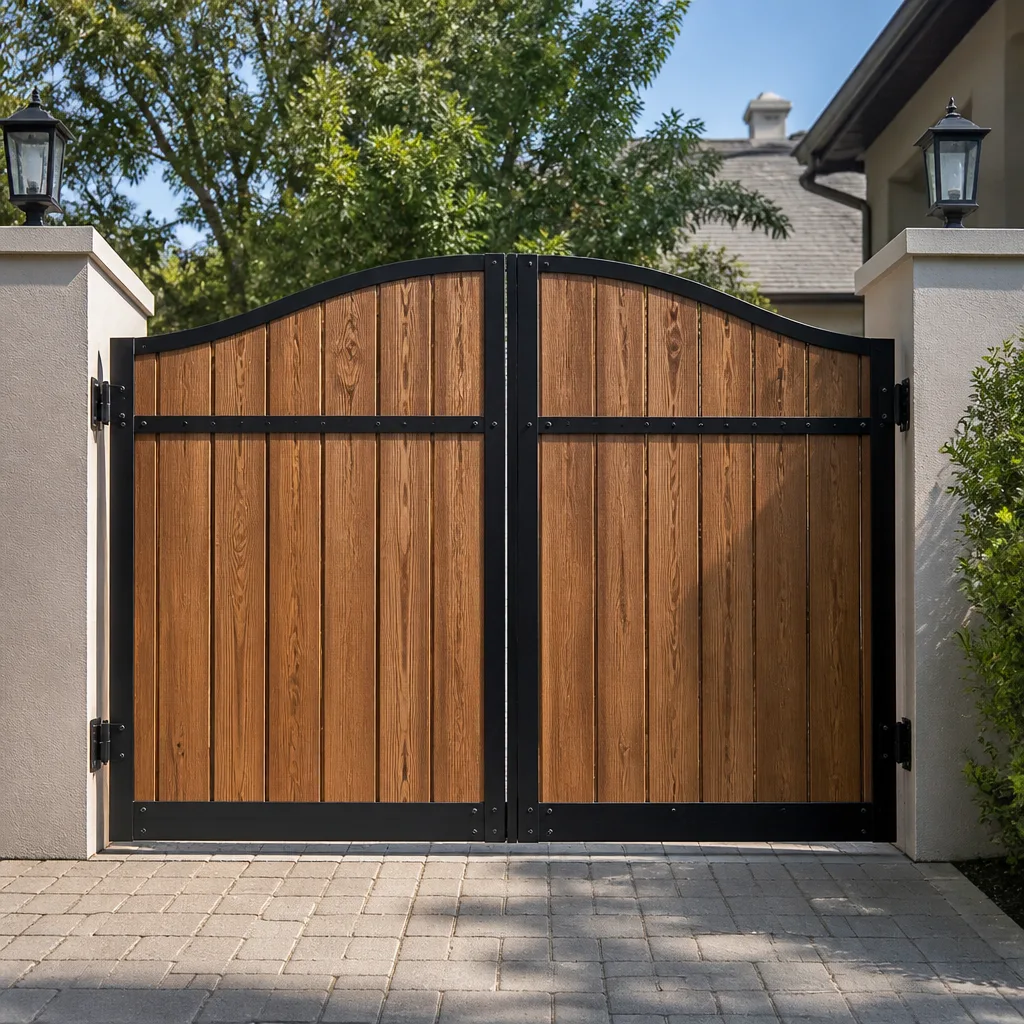 Wood & steel frame
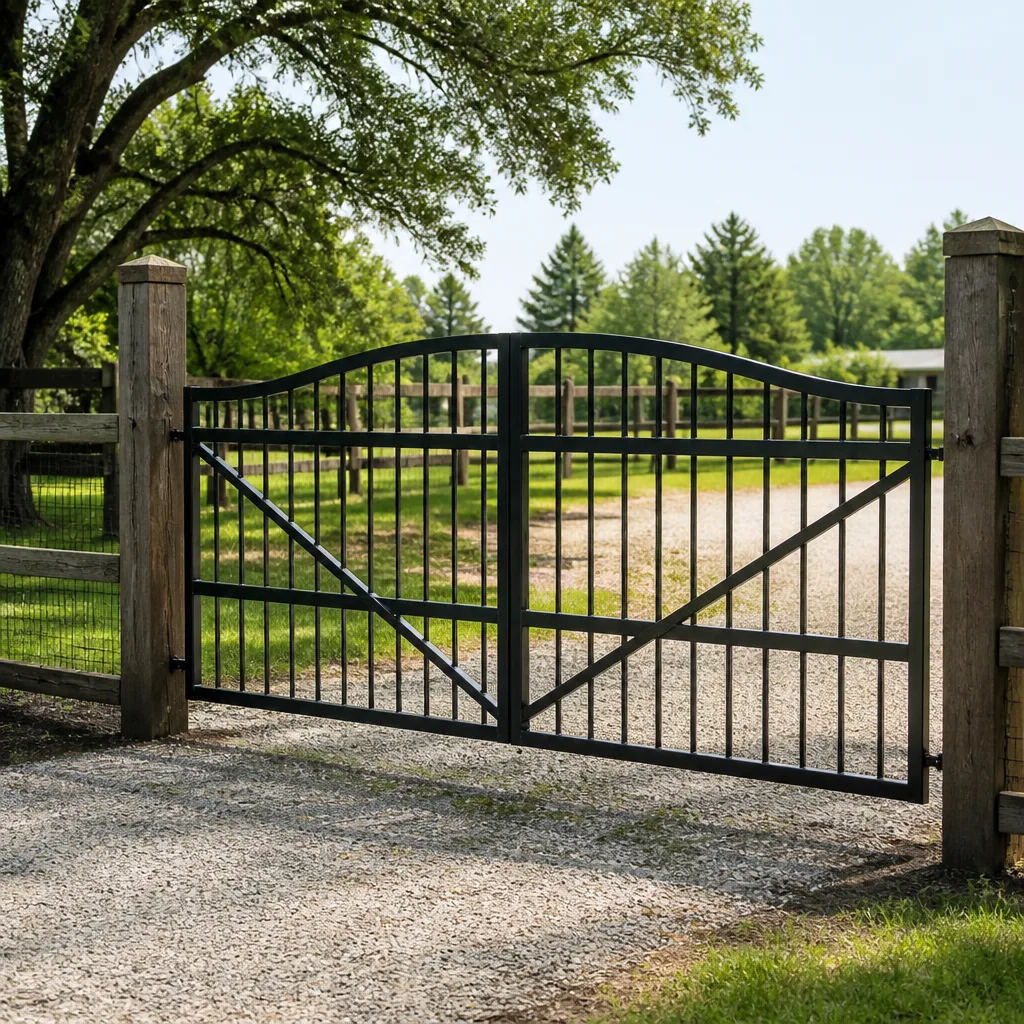 Farm & ranch
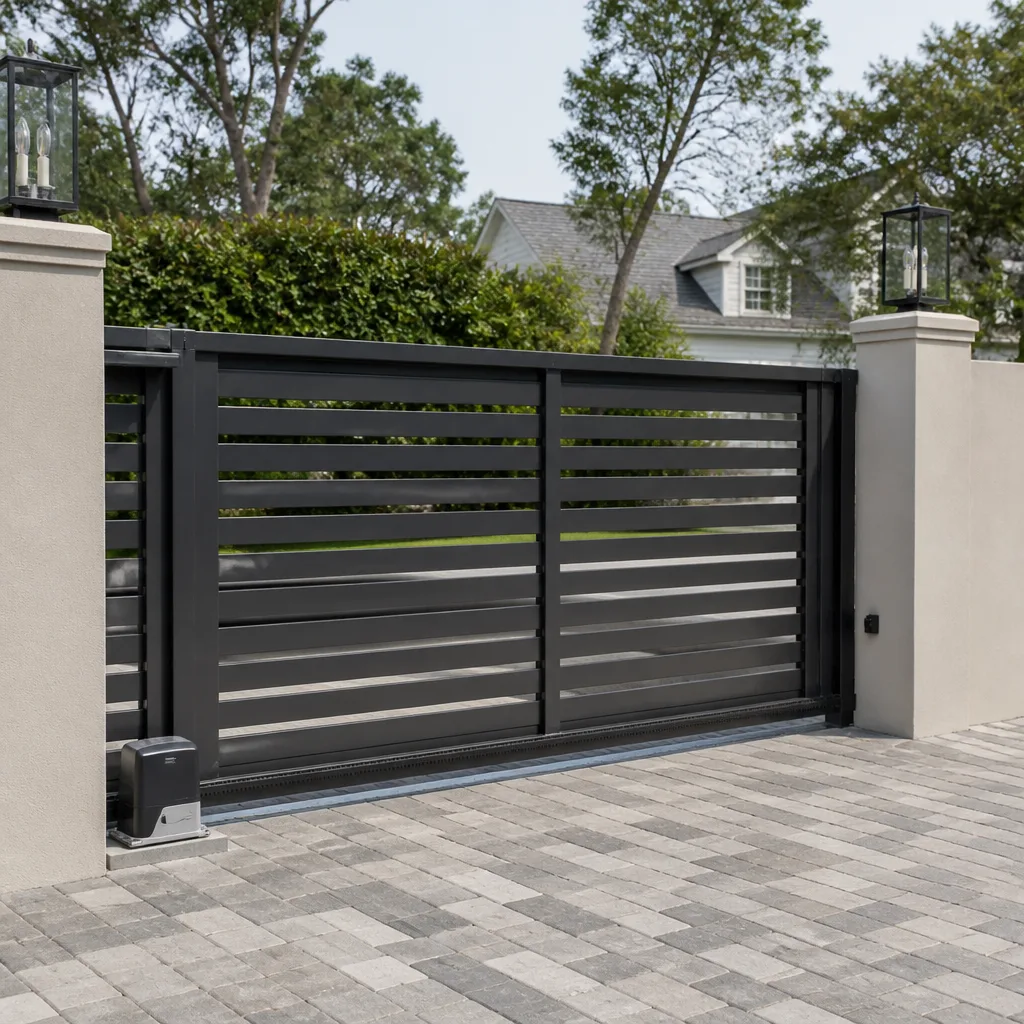 Sliding driveway gates
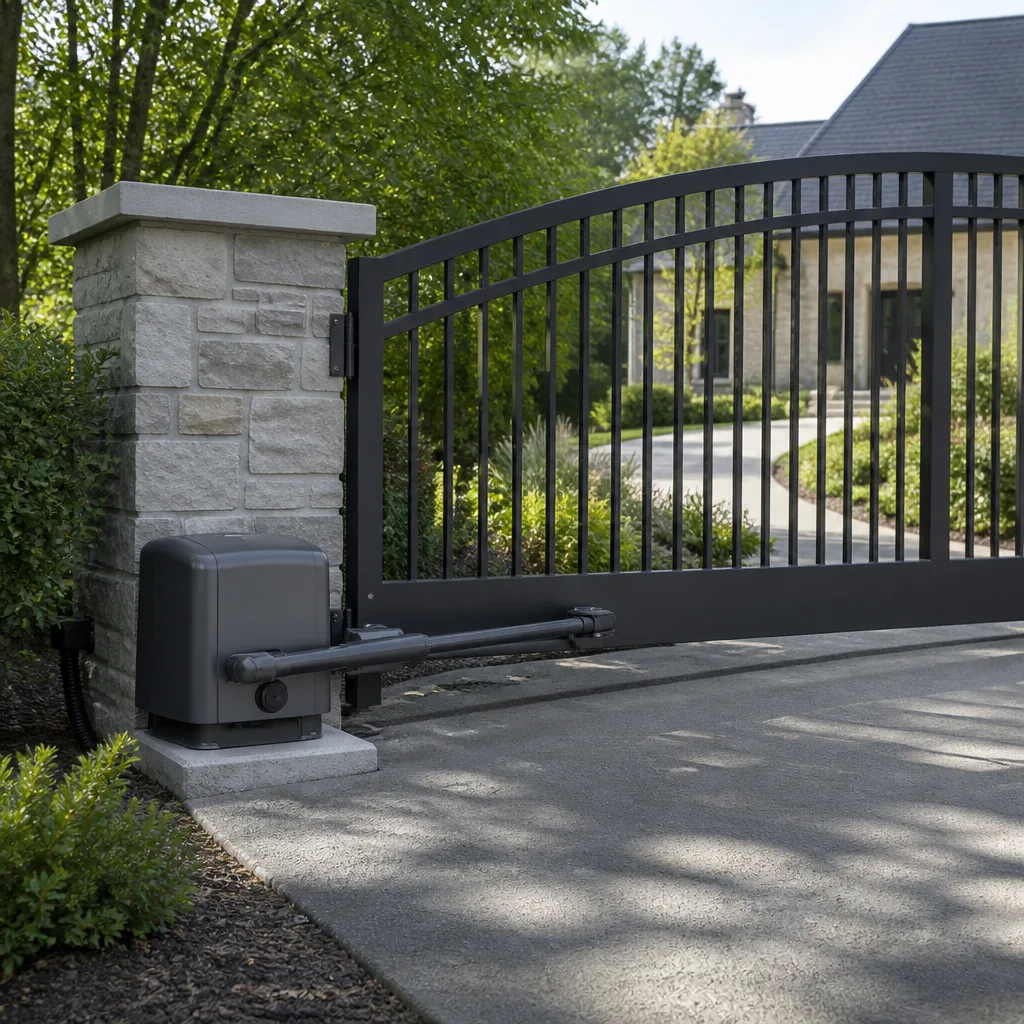 LiftMaster operators
Free on-site gate assessment - hinges, posts, and your LiftMaster or Nice gate operator checked before anything is quoted
The assessment is free and the quote is the invoice.
Get your free estimateGate Repair Troubleshooting in Lehigh Acres: Common Problems and How to Fix Them
A gate that reverses before it closes isn’t broken. It’s doing exactly what it was built to do: the safety sensor caught a signal it read as an obstruction and sent the gate back open. The motor is fine. The control board is fine. What’s usually wrong is a dirty or misaligned photo-eye, and most homeowners replace a perfectly good motor over a problem a cotton swab and five minutes can solve. In Lehigh Acres, that pattern repeats for a reason: our heat, our humidity, and our sandy soil push gate hardware in ways that have nothing to do with the parts homeowners suspect. This guide teaches you to read your gate’s symptoms the way a technician does, so you replace what’s actually broken and leave the rest alone.
Quick Answer
Most gate problems in Lehigh Acres come down to three things: a safety sensor that’s dirty or knocked out of alignment, an operator that lost its limit-switch calibration because summer heat expanded the gate posts, or insects and moisture in the control box or underground wiring. Before you buy a motor or call anyone, check the sensor lenses, watch the indicator lights on the control board, and test the gate by hand with the operator disengaged. Those three checks identify the majority of failures and tell you whether the problem is mechanical, electrical, or environmental.
Styles & brands we work with
- Wrought iron
- Wood & steel frame
- Farm & ranch
- Sliding driveway gates
- LiftMaster operators
Table of Contents
- How to Read Your Gate’s Symptoms Before You Call Anyone
- Motor Failure vs. Logic Board Failure: How to Tell Them Apart
- Why Lehigh Acres Heat Throws Off Limit Switches
- Fire Ants in the Control Box and Conduit: The Hidden Culprit
- Symptom-to-Cause Matrix: Five Common Gate Failures
- Safe DIY Fixes vs. Jobs That Need a Technician
- Manual vs. Electric Gates: Different Troubleshooting Paths
- Diagnosing by Brand: Why Operator Logic Matters
How to Read Your Gate’s Symptoms Before You Call Anyone
A gate tells you what’s wrong before it stops working entirely. Most failures announce themselves in stages: a little hesitation, a slightly slower swing, an occasional reversal, then a full stop. Learning to read those stages saves you from the most expensive mistake in gate repair, which is replacing the operator when the problem lives somewhere else entirely.
Start with what the gate is doing, not what you think is broken. The location of the failure matters as much as the symptom. A gate that won’t move at all is a different problem from a gate that moves and then reverses. A gate that grinds sounds like a mechanical issue but is sometimes a worn hinge or a track obstruction. A gate that opens fine from the remote but ignores the keypad isn’t a motor problem at all.
Three checks narrow it down fast:
- Watch the indicator lights on the control board. Most operators flash a specific code or sequence when a safety input trips. LiftMaster and Elite boards, for example, cycle a diagnostic LED pattern that tells you which input is calling. Write down what you see before you touch anything.
- Disengage the operator and move the gate by hand. Almost every automatic gate has a manual release key or lever. With the operator disengaged, the gate should swing or slide with light effort. If it binds, drags, or grinds, the problem is mechanical, not electrical, and no amount of motor replacement will fix it.
- Test the safety sensors separately. Walk through the beam while the gate is opening. If the gate reverses, the sensors are working and the fault is elsewhere. If nothing happens, the sensor pair may be dead, misaligned, or blocked by debris.
In Lehigh Acres, that third check catches more problems than the first two combined. Sand, dust, and pollen coat photo-eye lenses within weeks during the dry season, and afternoon storms splash grit onto them from the opposite direction. A gate that reverses before closing and reverses again on the retry is almost always telling you about a sensor, not a motor.
Motor Failure vs. Logic Board Failure: How to Tell Them Apart
The motor and the logic board are two different parts, and confusing them is the most common way homeowners waste money on a gate repair in Lehigh Acres. The motor is the mechanical muscle that moves the gate. The logic board is the brain that tells the motor when to start, stop, and reverse. A dead motor and a dead board both leave you with a gate that doesn’t move, but they fail in different ways.
Here’s how to distinguish them:
- Listen for the motor. If you hear a hum, a click, or a strain when you press the remote, the motor is getting power and the board is likely commanding it. The problem may be mechanical (a jammed gate, a broken hinge, a stuck track) rather than electrical.
- Watch the board lights. A live control board shows power and status LEDs. No lights at all usually means a power supply or transformer issue, not a dead board. A board that lights up but never sends a command to the motor may have failed relays or a blown fuse on the board itself.
- Listen for a click at the board. When you press the remote, a working board clicks as its relay engages. No click, no command, which points to the board or the receiver, not the motor.
- Test the manual release. If the gate moves freely by hand with the operator disengaged, the mechanical side is healthy and the fault sits in the electronics. If it drags by hand, the motor may be fine and the gate itself is the problem.
The other factor is brand logic. Each operator brand reports faults differently. A FAAC board and a Mighty Mule board use different LED sequences and different fuse locations. DoorKing commercial control boards have their own diagnostic patterns, and BFT operators use a different flash-code convention. Knowing how a specific brand signals a fault is the difference between a five-minute diagnosis and a guessing game. That’s the reason a specialist who works across LiftMaster, FAAC, BFT, Linear, Viking, Ghost Controls, DoorKing, Elite, and Mighty Mule reads a symptom faster than a generalist: the diagnosis starts with brand, not with the parts bin.
Why Lehigh Acres Heat Throws Off Limit Switches
Limit switches tell the operator where the gate should stop. They’re calibrated to a set position, and when that position shifts by even a fraction of an inch, the gate either reverses too early, slams too hard, or overshoots and pushes against its own stop. In Lehigh Acres, the calibration drifts every summer because the gate posts and gate frame expand in the heat.
Aluminum and steel both expand with rising temperature, and a long driveway gate sitting in direct afternoon sun can grow measurably over the course of a day. The expansion isn’t dramatic, but limit switches are calibrated to tolerances measured in fractions of an inch, and a few thousandths of expansion at the hinge end turns into a visible shift at the latch end. When the gate frame grows, the operator’s stopping point lands in the wrong place, and the gate either fails to latch or reverses prematurely.
You can verify heat-related drift without any tools:
- Watch the gate open and close at dawn, before the sun hits the gate directly.
- Watch it again at mid-afternoon, when the gate has been in direct sun for hours.
- Compare the two cycles. If the gate stops cleanly in the morning but overshoots, reverses, or fails to latch in the afternoon, heat expansion is throwing off the limit switch calibration.
This happens most on long swing gates and on slide gates with a long travel path, and it’s more pronounced on gates with dark finishes, which absorb more heat. The fix isn’t to replace anything. It’s to recalibrate the limit switches and, if the drift repeats every year, to adjust the gate’s operating travel so it tolerates the seasonal swing. A technician who knows what a Lehigh Acres summer does to aluminum will check the limit switches before checking the motor, because the pattern is common here and rare in cooler climates.
Fire Ants in the Control Box and Conduit: The Hidden Culprit
Here’s a failure mode most troubleshooting guides don’t mention, and it’s common in Lehigh Acres: fire ants nesting inside gate operator control boxes and the underground wiring conduit that feeds them. Sandy soil, warm ground temperatures year-round, and the small protected cavities in a control enclosure make gate infrastructure a favorite nesting site for fire ants, and a single colony can take down a gate with no mechanical fault at all.
The ants cause problems in three ways. They build mounds inside the control box that push against wiring and short terminals. They chew through wire insulation and nest inside the conduit run, which is harder to see and harder to fix. And they bridge across circuit board contacts, which produces intermittent faults that look like a failing board but aren’t. A gate that works for a few days, fails for a few days, and works again is a classic sign of insect intrusion or a loose connection in a conduit run.
Identifying ant intrusion is straightforward:
- Open the control enclosure and look for sandy soil piles, fine debris, or actual insects near terminals and wiring.
- Check where the conduit enters the box. Ants often enter through the conduit and build a nest at the top of the run.
- Look for chewed insulation on low-voltage wiring near the entry point.
- Check the ground at conduit entry points for active mounds or fine sandy trails.
Fixing an ant problem changes the repair approach. Killing the colony without cleaning the nest and repairing the chewed wiring doesn’t solve anything, and a board replacement with a live colony still inside the enclosure will fail again. A proper repair means clearing the nest, repairing chewed low-voltage wiring, replacing or treating the affected board if it’s been bridged, and closing the entry points so ants can’t re-enter. For gates in Lehigh Acres with underground wiring runs, this is part of a routine inspection rather than a rare specialty. When a gate doesn’t behave the way it should and the symptoms don’t match the usual suspects, insect intrusion is worth checking.
Symptom-to-Cause Matrix: Five Common Gate Failures
Every gate failure has a short list of likely causes, and matching a symptom to its cause is the fastest route to the right repair. Here are the five most common failure modes we diagnose in Lehigh Acres, with the checks that isolate each one.
1. Gate Won’t Open
- If the remote clicks but nothing moves: check the manual release, the gate track, and the hinges first. A jammed gate can’t be moved by a working motor.
- If the board shows no lights: check the power supply and transformer before assuming a dead board.
- If the keypad works but the remote doesn’t (or vice versa): the problem is in the receiver or the remote programming, not the motor.
2. Gate Opens but Won’t Close
- First suspect: the safety sensors. A blocked or misaligned photo-eye tells the board there’s an obstruction and prevents the close cycle. Clean the lenses and check that the sensor LEDs pair up.
- Second suspect: the loop detector or safety edge. A failed loop detector in the driveway or a shorted safety edge will hold the gate open.
- Third suspect: a limit switch out of calibration. If the board thinks the gate is already at its close limit, it won’t command a close.
3. Gate Moves Slowly or Stalls
- Mechanical drag first. Disengage the operator and push the gate by hand. If it’s stiff, the hinges, rollers, or track need attention before the motor does.
- Voltage drop second. Long underground wiring runs and corroded connections can starve the operator of voltage, slowing the motor.
- Motor or capacitor third. A failing motor capacitor on residential operators like a Ghost Controls or Mighty Mule will slow the gate before it stops it entirely.
4. Gate Makes a Grinding Noise
- Look at the track, rollers, and hinges. Grinding on a slide gate is usually a worn roller or debris in the track. On a swing gate, it’s usually a dry or worn hinge.
- Check the operator’s gear for a swing gate. A grinding noise from inside the operator housing is a mechanical fault in the gear or arm, not a board problem.
- Stop cycling the gate while it’s grinding. Continued operation with a mechanical fault can damage the motor and turn a hinge repair into a motor replacement.
5. Remote Works but Keypad Doesn’t
- The keypad is a separate receiver input. A keypad that stopped responding is usually a power, battery, or programming issue rather than an operator failure.
- Check the keypad’s own power source first. Many keypads run on batteries, and a dead battery feels like a dead gate.
- If the keypad wiring enters the same control box as the operator, check for insect intrusion or a loose terminal in the shared enclosure.
Reading the symptom before touching the gate is the discipline. In our experience, at least half the parts replaced on gates in Lehigh Acres fail because the symptom pointed at the motor when the real cause was the sensor, the limit switch, or a nest of ants in the wiring.
Safe DIY Fixes vs. Jobs That Need a Technician
Some gate problems are safe to fix yourself. Others involve hazards that can injure you or damage the operator, and knowing the line is the difference between a five-minute fix and a hospital visit. Here’s the split we walk homeowners through on every gate repair call.
Safe DIY fixes:
- Cleaning photo-eye lenses. A soft cloth and a little water remove dust, pollen, and grit. Don’t use abrasives on the lens.
- Replacing remote and keypad batteries. Straightforward and low-risk. Check the keypad’s own power source before assuming a gate fault.
- Clearing debris from a track or slide path. A brush and a leaf blower clear the most common cause of a slide gate grinding or stalling.
- Lubricating hinges and rollers. Follow the operator or hardware manufacturer’s recommendation and don’t overdo it.
- Adjusting limit switches on a low-voltage operator if the manufacturer’s manual shows the procedure clearly and the gate moves freely by hand. If the procedure isn’t clear, wait for a technician.
Jobs that need a technician:
- Replacing or repairing a control board. Boards carry capacitors and 120-volt connections even after power is disconnected.
- Re-wiring a loop detector, safety edge, or any low-voltage wiring in a conduit run. This is where fire-ant damage hides, and mis-wired safety inputs create a gate that looks fixed until the next close cycle.
- Any work inside the operator housing on a high-voltage line. Line voltage is dangerous, and a shock from a 120-volt circuit is a serious injury. Turn the breaker off and call a technician.
- Diagnosing a board-level fault on a commercial operator like a DoorKing or FAAC system. The diagnostic codes on commercial boards are specific to each brand and misreading them damages parts.
A general safety rule applies to every automated gate: don’t hold the gate open or stand between the gate and its post while the operator is engaged. Heavy panels can crush and slide gates can come off their track. If the gate is behaving erratically, disengage the operator and use the gate manually until a technician can look at it.
If you’re unsure which category a problem falls into, that’s the moment to call. Gate Repair Lehigh Acres handles both electric gate repair and manual gate problems, so the diagnosis doesn’t swap between two companies. Call (888) 361-0704 for a free estimate.
Manual vs. Electric Gates: Different Troubleshooting Paths
A manual gate and an electric gate fail for completely different reasons, and troubleshooting starts by identifying which kind of gate you’re working with. Manual gates fail mechanically: hinges, latches, posts, and alignment. Electric gates fail mechanically or electronically, and the electronics side accounts for the majority of faults.
For a manual gate, the troubleshooting path is short and mostly about alignment and friction:
- Lift the gate slightly at the latch end to see if the post has settled. Sandy soil and heavy summer rain can shift a post enough to throw the gate out of square.
- Check the hinges for wear. A hinge that has lost its pin or turned dry will make the gate sag and drag.
- Check the latch alignment. A gate that latches in cool weather and fails to latch in heat is almost certainly expanding at the frame.
- Look at the post footing. Posts need to sit at the proper depth for the gate’s weight. A leaning post means the footing has shifted.
For an electric gate, the troubleshooting path runs through the control box first:
- Look at the board before anything else. Indicator lights and error codes tell you which input is failing. Most residential boards, including LiftMaster and Elite models, report safety-input faults through a specific flash pattern.
- Test the safety devices. Photo-eyes, safety edges, and loop detectors all feed the board. A single failed safety input can stop the gate from closing, and each device has its own test.
- Check the power source. A low-voltage transformer that’s failing will cause intermittent faults that look like board problems.
- Look for insect damage and moisture. Ants in the box and moisture in the conduit both create intermittent faults that are hard to trace without opening the enclosure.
Knowing which path you’re on keeps you from wasting time on the wrong component. Homeowners with a manual gate don’t need to worry about boards. Homeowners with an electric gate shouldn’t start with the hinges unless the manual release tells them the mechanical side has failed. Getting the classification right is the first step, and it’s the one we confirm before we quote any repair in Lehigh Acres.
Diagnosing by Brand: Why Operator Logic Matters
Gate operators don’t fail the same way, even when they fail for the same reason. A residential operator from Mighty Mule or Ghost Controls reports a fault differently than a commercial DoorKing or FAAC system, and the diagnostic procedure changes with the brand. This is why a specialist who works across many brands diagnoses faster than someone guessing from a generic manual.
Here’s how brand logic shapes a diagnosis:
- Residential operators like Mighty Mule and Ghost Controls use simple flashed error codes on the control board. Reading the code correctly points to a specific input or output, and the fix is often at that input rather than at the motor.
- LiftMaster and Elite boards use diagnostic LED sequences and status codes that distinguish safety-input faults from motor faults. The difference matters because the safety-input fix is usually a sensor or a wiring repair, not a board replacement.
- FAAC and BFT commercial operators use proprietary diagnostic conventions and different fuse locations than budget residential units. Misreading a commercial board’s error code can send you chasing a part that was never the problem.
- DoorKing access-control systems combine operator diagnostics with access-control logic, so a keypad failure and a gate failure are diagnosed through different code paths even when the symptom looks the same.
The same principle applies to Lehigh Acres homeowners facing a manual gate or an electric gate that only seems broken. A manual gate with a swing arm that fails to latch in the summer is a limit switch problem on an electric operator, or a hinge and post alignment problem on a manual gate. The symptom looks similar. The diagnosis runs through completely different logic. That’s why “repair first, replace only when it makes sense” only works when the technician knows the brand. A generalist who hasn’t seen that specific operator’s diagnostic codes will order parts to guess, and the parts bill climbs until something gets replaced that shouldn’t have been.
Common Mistakes to Avoid
- Replacing the motor before checking the sensors. A dirty photo-eye can look exactly like a failed motor. Clean the lenses and check the safety inputs before buying a part.
- Ignoring the manual release. Disengaging the operator and pushing the gate by hand is the single fastest check on any gate. Skipping it means guessing about mechanical versus electrical faults.
- Clearing an ant nest without repairing chewed wiring. Killing the colony leaves the damaged insulation in place, and the gate fails again as soon as the wiring shakes loose. In Lehigh Acres, ants in the conduit are a repair that includes the wiring, not just the nest.
- Adjusting limit switches without writing down the starting position. If you lose track of the original calibration, the gate can end up worse than it started. Photograph or mark the position first.
- Assuming the remote is the problem when the keypad fails. The keypad and remote are separate receiver inputs. A dead keypad almost never points to a dead operator.
- Buying a board before powering down the operator. Boards are damaged by current, not by age. Turn the breaker off before touching anything inside the enclosure.
- Cycling a grinding gate to “see if it fixes itself.” Grinding indicates a mechanical fault, and every cycle wears the motor and arm further. Stop and diagnose.
See the difference
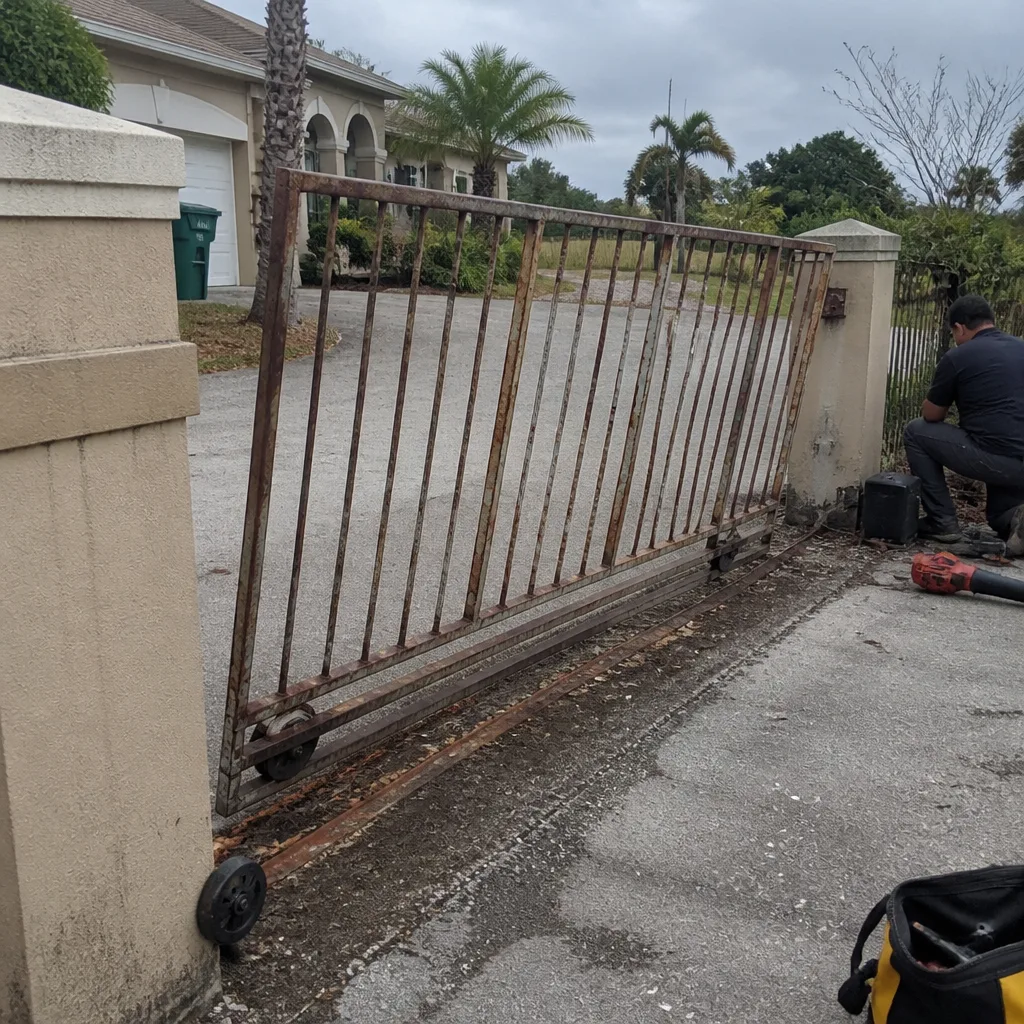 Before
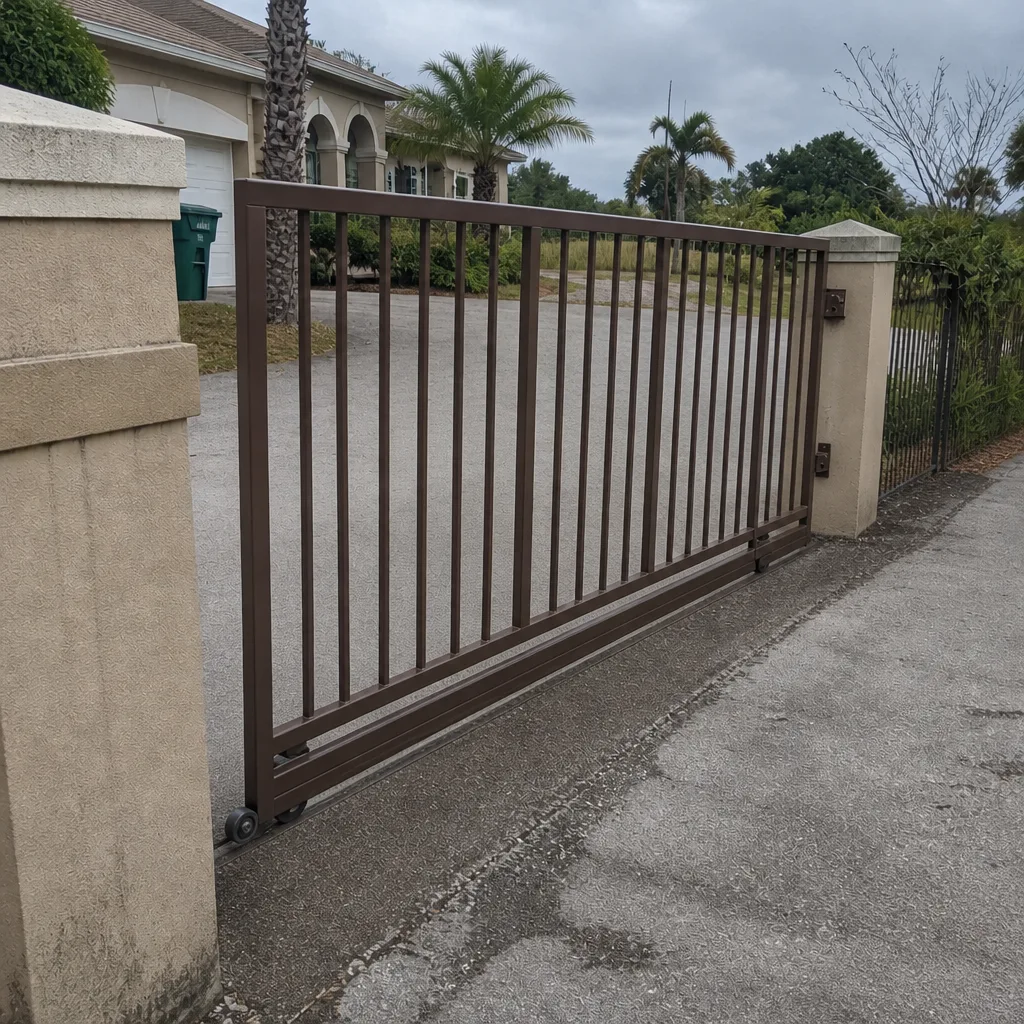 After
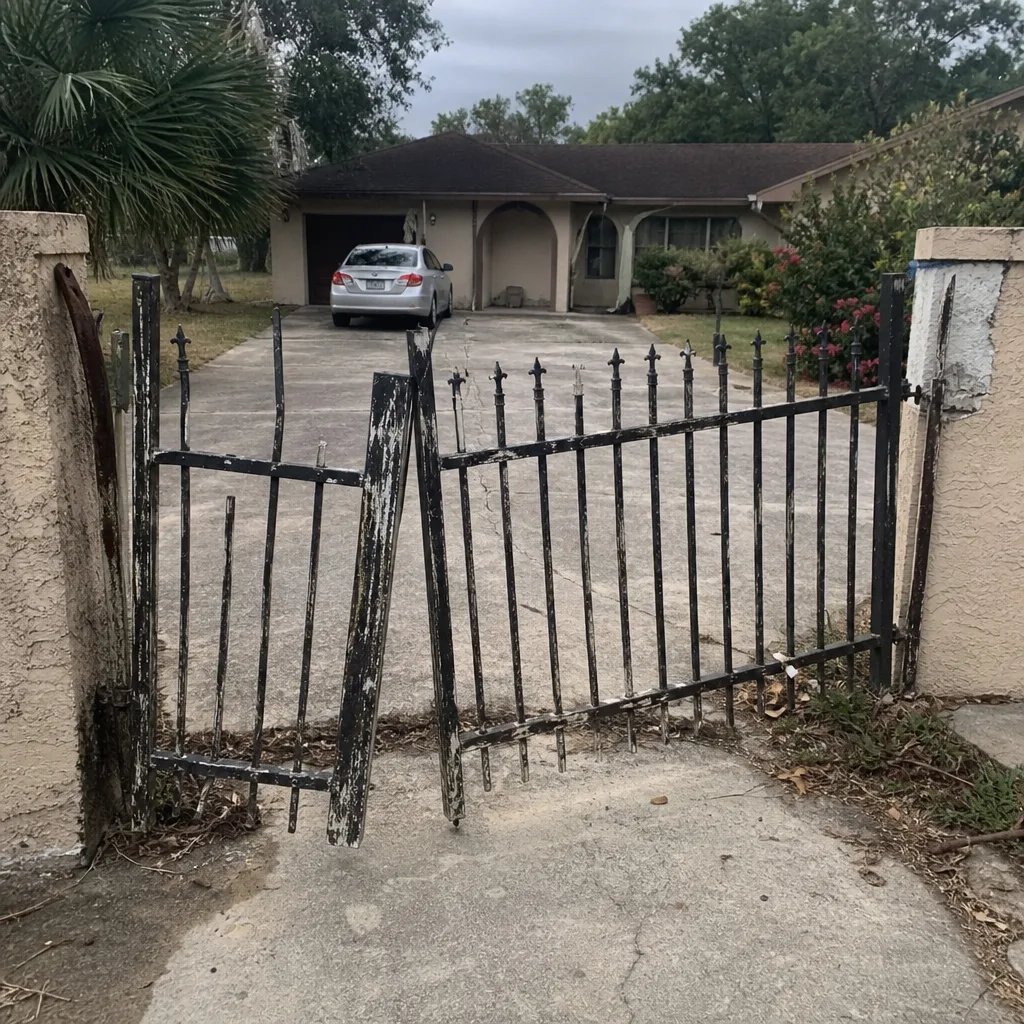 Before
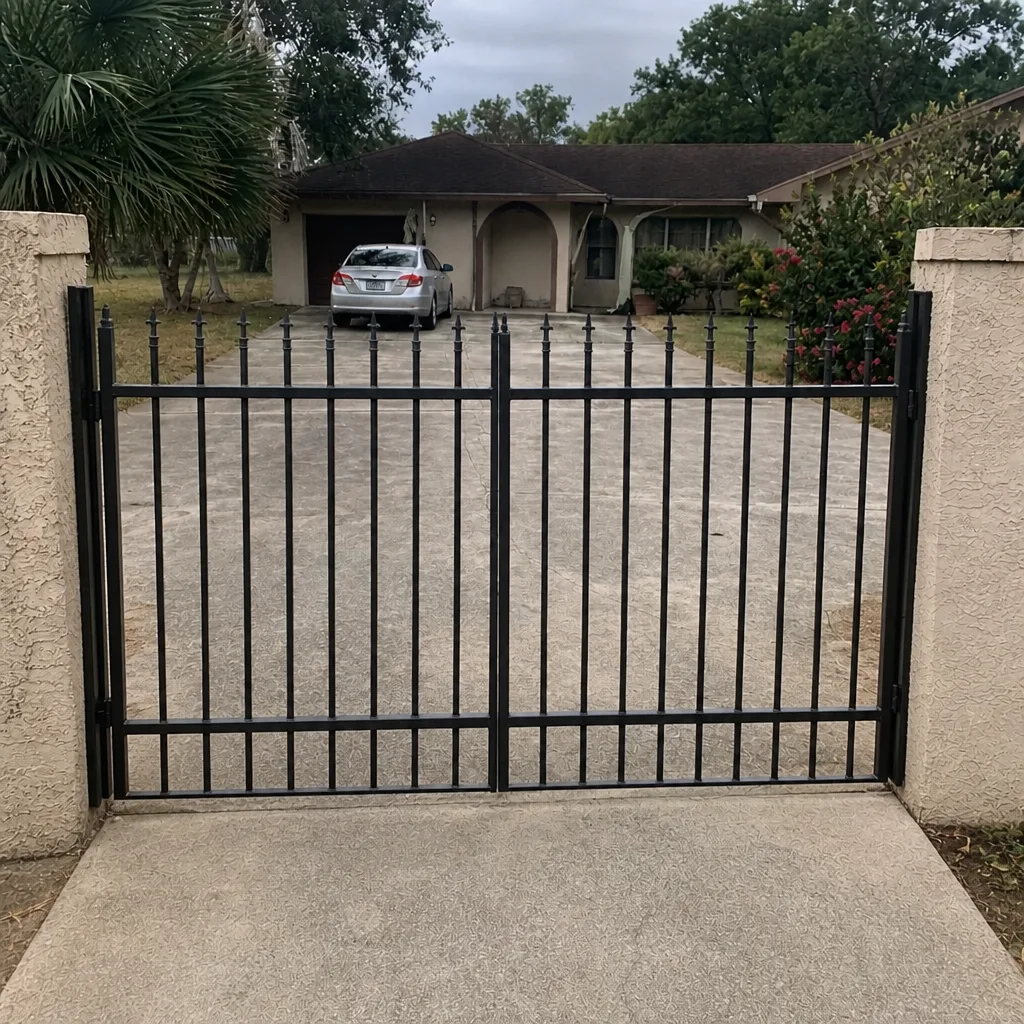 After
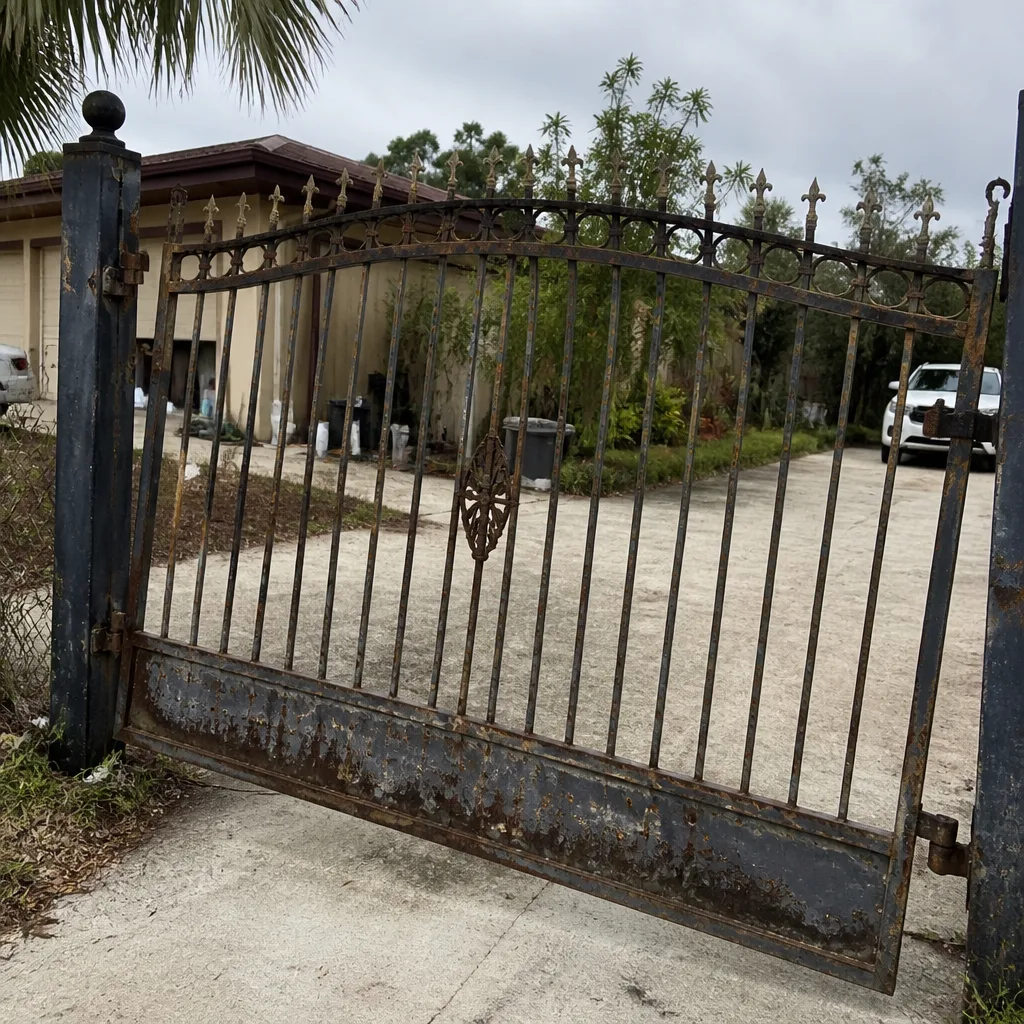 Before
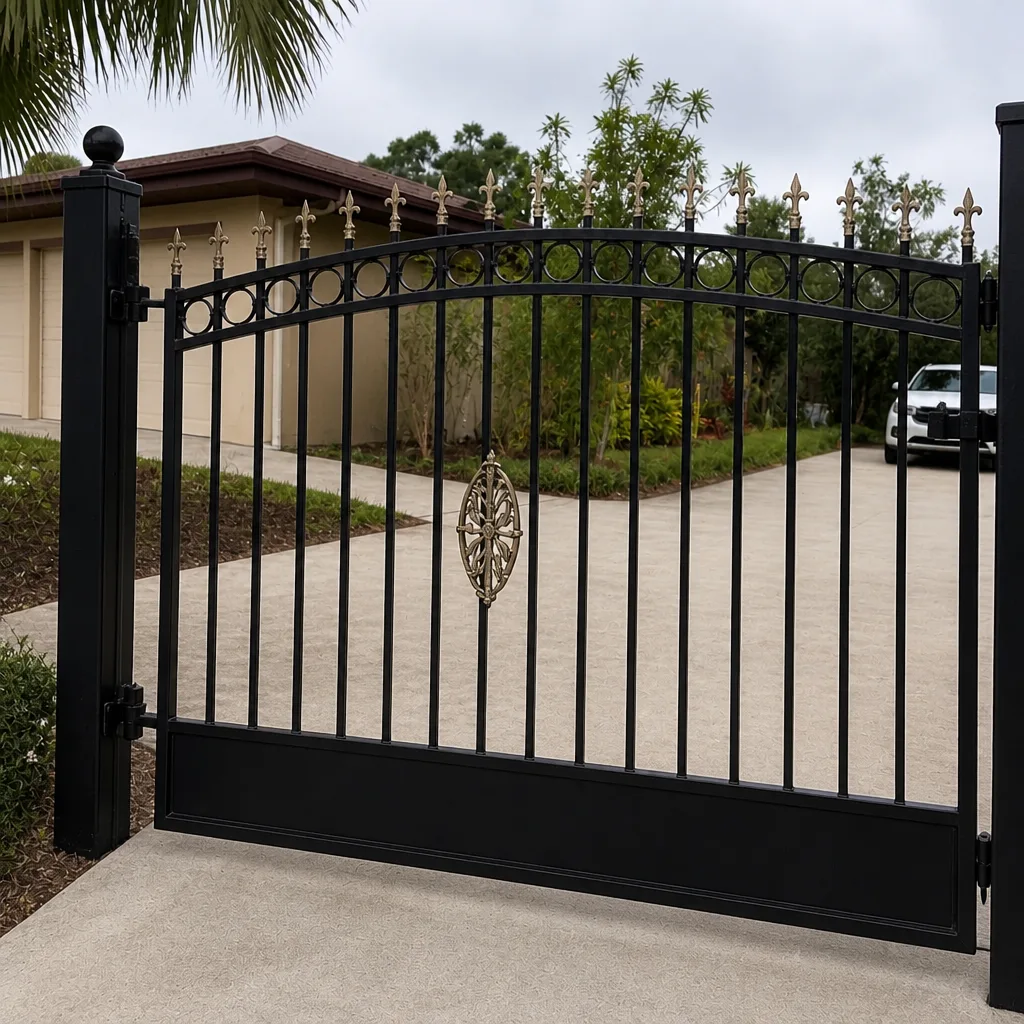 After
When to Call a Professional
Call a technician when the problem lives inside the control enclosure, involves low-voltage or line-voltage wiring, or involves a symptom that recurs after a basic reset. Board-level faults, loop detector wiring, and safety-edge repairs belong in the hands of a trained technician, and a heavy gate panel moving unpredictably is a hazard you shouldn’t troubleshoot from arm’s length. If the gate has reversed, stalled, or failed to latch more than twice in a week, that’s a pattern, not a fluke, and the diagnosis should happen on-site rather than by phone.
Gate Repair Lehigh Acres offers free estimates in Lehigh Acres, and we work on both manual and automated gates. Our technicians have up to 14 years of experience and are familiar with the operator brands you’ll find on driveways and access-controlled properties across the area. Call (888) 361-0704 to set up a diagnostic visit. We answer 24/7, and fast dispatch runs from 7am to 7pm, Sunday through Friday.
Frequently Asked Questions
Why does my gate open but not close in Lehigh Acres?
In almost every case, a gate that opens but won’t close is a safety-sensor problem. The photo-eyes are dirty, misaligned, or blocked by debris, and the control board interprets the missing signal as an obstruction. Clean the sensor lenses and check that their indicator LEDs are lit and paired. If that doesn’t fix it, a safety edge or loop detector may be holding the gate open. Call (888) 361-0704 for a free estimate if the sensors check out and the gate still won’t close.Cleaning sensors, replacing remote and keypad batteries, clearing track debris, and lubricating hinges are safe to do yourself. Anything that involves opening the control enclosure, touching internal wiring, replacing a control board, or re-wiring a loop detector or safety edge should go to a technician. The control box carries live line voltage and capacitors that hold a charge after the breaker is off. When in doubt, call a professional before you open the enclosure.
A gate that reverses before closing is usually doing what it was programmed to do: the safety sensor detected an obstruction that wasn’t there. The photo-eye reads a dirty lens, a misaligned pair, or debris in the beam as a car in the way, and the board reverses the gate. Clean the lenses, realign the pair, and check for grit from a recent storm. If the reversal continues, the sensors may have failed and need replacement. Call (888) 361-0704 for an exact quote.
A grinding noise usually points to a mechanical problem: a worn roller on a slide gate, a dry or damaged hinge on a swing gate, or debris in the track. On a swing gate with an arm, grinding can come from inside the operator housing at the gear or arm connection. Stop cycling the gate until it’s diagnosed, because continued operation can turn a hinge repair into a motor replacement. Call (888) 361-0704 for a fast diagnostic visit.
That pattern points to heat expansion, and it’s common in Lehigh Acres. Aluminum and steel gate posts and frames expand in the summer sun, which throws the operator’s limit switch calibration out of tolerance. The gate stops cleanly while it’s cool and overshoots or reverses once it’s been in direct sun for hours. The fix is to recalibrate the limit switches and, if the drift repeats every year, adjust the gate’s operating travel. Call (888) 361-0704 for a free estimate.
Yes, and it’s more common here than most homeowners expect. Fire ants nest in control boxes and underground wiring conduit, where they build mounds that shift wiring, chew insulation, and bridge circuit board contacts. The result is intermittent failures that look like a dying board. Fixing an ant problem means clearing the nest, repairing any chewed wiring, and sealing the entry points, not just replacing the board. Call (888) 361-0704 for a free estimate.
The Bottom Line
Most gate failures in Lehigh Acres aren’t motor failures at all. They’re sensor faults, heat-driven limit switch drift, and insect intrusion in the control box or underground conduit, and each one has a cheap, direct fix if you read the symptom the right way. Before you call anyone or buy a part, check the photo-eyes, disengage the operator and push the gate by hand, and look at what the control board’s indicator lights are saying. If the problem sits inside the enclosure, involves line voltage, or repeats in a pattern, that’s a technician’s job. We work on both manual and electric gates and across LiftMaster, FAAC, BFT, Linear, Viking, Ghost Controls, DoorKing, Elite, and Mighty Mule operators, so the diagnosis runs from brand logic rather than guesswork. Call Gate Repair Lehigh Acres at (888) 361-0704 for a free estimate. We answer 24/7, and fast dispatch runs from 7am to 7pm, Sunday through Friday.
Written by the team at Gate Repair Lehigh Acres.