
Last updated November 15, 2026
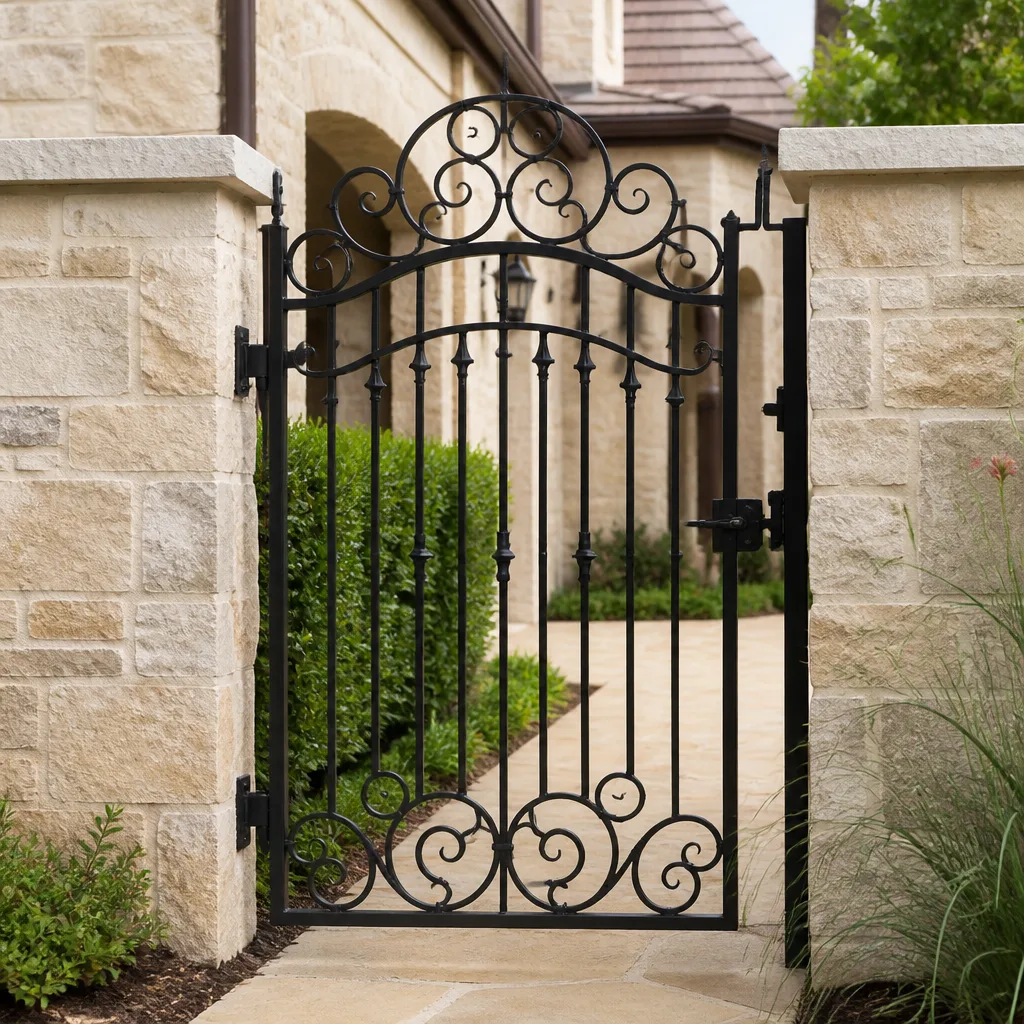 Wrought iron
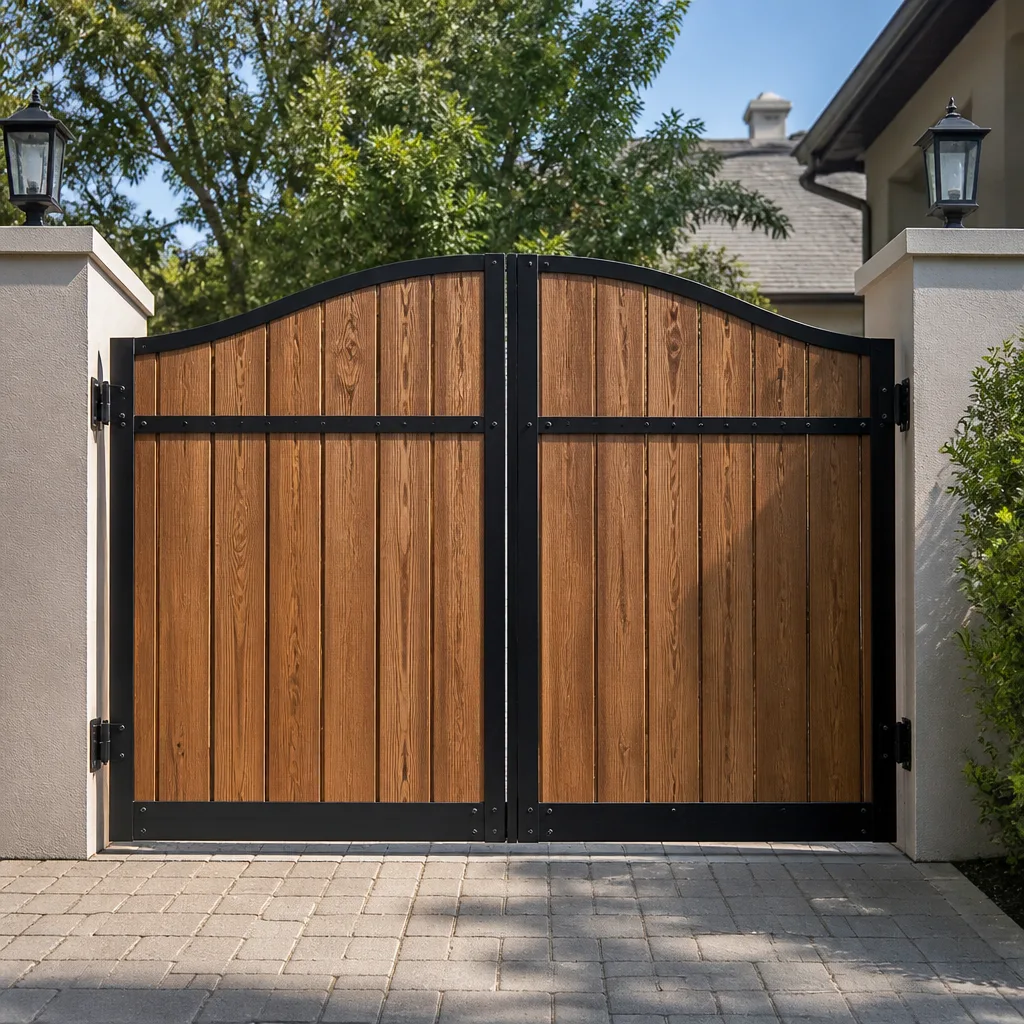 Wood & steel frame
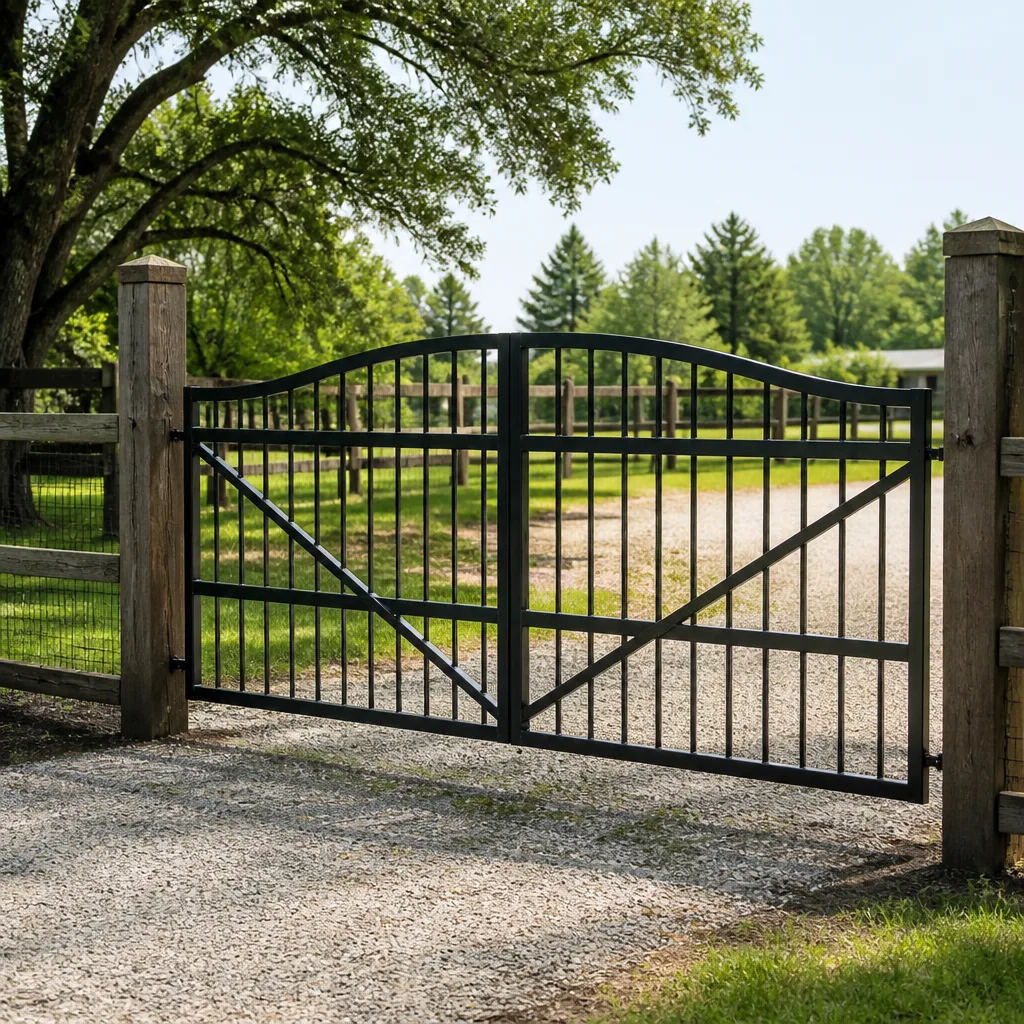 Farm & ranch
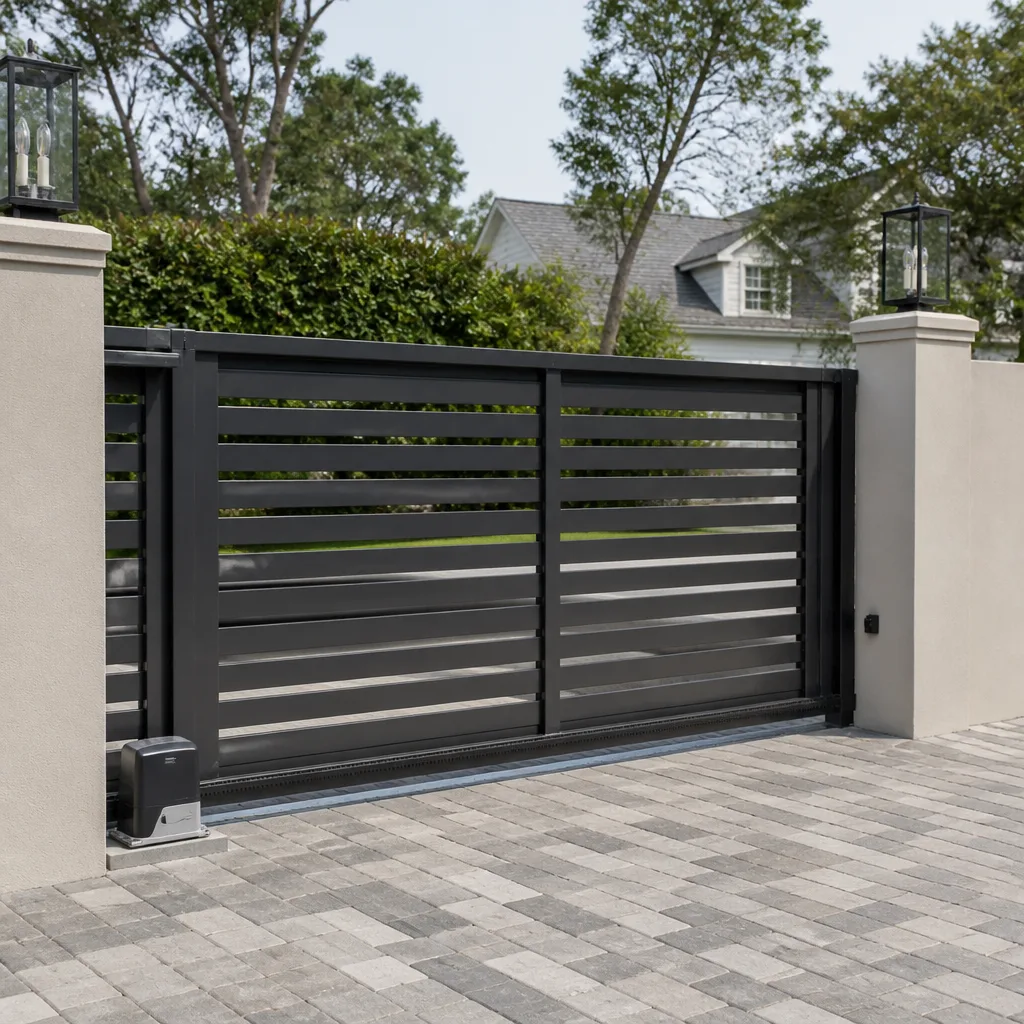 Sliding driveway gates
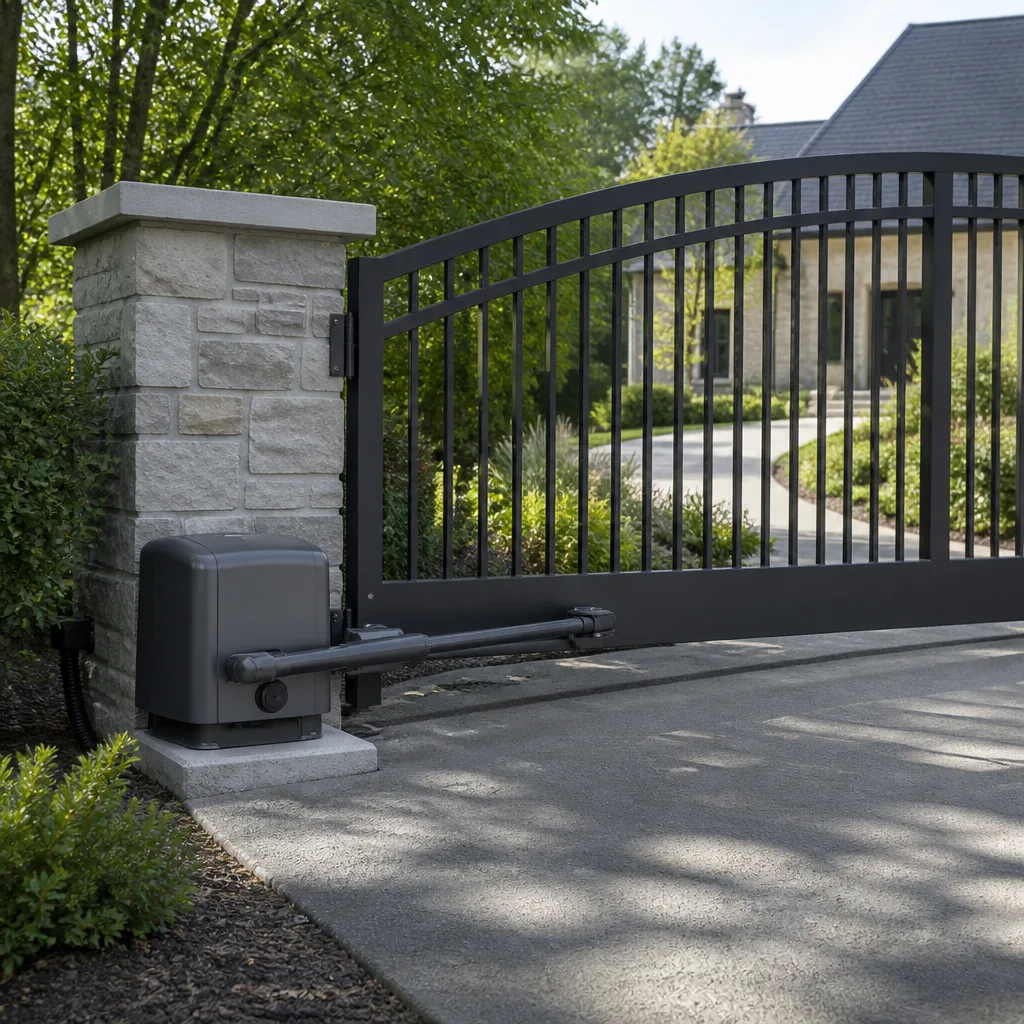 LiftMaster operators
Free on-site gate assessment - hinges, posts, and your LiftMaster or Nice gate operator checked before anything is quoted
The assessment is free and the quote is the invoice.
Get your free estimateGate Repair Maintenance Schedule: What to Do and When
Manufacturers write maintenance intervals for an average climate. Lehigh Acres is not an average climate. We get over 2,600 hours of sunshine a year and a wet season that drops half the annual rain in six months, so a gate that follows a generic schedule ages faster than the manual predicts. Metal expands and contracts through humid afternoons, hinges dry out, and UV film builds up on solar panels until the opener is running on fumes. This guide lays out a real calendar for Lehigh Acres: what to check monthly, what to do before the rains hit in April, and what to inspect once hurricane season passes in November.
Quick Answer
A gate maintenance schedule in Lehigh Acres should follow the local climate, not the manufacturer’s generic intervals: inspect and lubricate hinges, rollers, and latches monthly, do a full pre-rainy-season prep in April (drainage, loop detectors, panel cleaning), and schedule a professional inspection each November after storm season. Annual professional checks should cover the operator, control board, wiring, safety sensors, and heavy hardware. Everything in between is a monthly owner walk-around that catches most failures before they leave you locked out.
Styles & brands we work with
- Wrought iron
- Wood & steel frame
- Farm & ranch
- Sliding driveway gates
- LiftMaster operators
Table of Contents
- Why Average Maintenance Schedules Fail in Lehigh Acres
- The Monthly Owner Check: 15 Minutes That Catches 70% of Failures
- Your Month-by-Month Gate Calendar for Lehigh Acres
- Lubrication That Survives Florida Humidity
- Solar Panel Checks for Solar-Powered Openers
- Underground Loop Detectors After Heavy Rain
- What Needs an Annual Professional Inspection
- When Maintenance Becomes a Repair Call
Why Average Maintenance Schedules Fail in Lehigh Acres
Gate openers are engineered and tested in mild conditions, then shipped everywhere. The service intervals printed in the manual assume moderate swings in temperature and moderate humidity. Lehigh Acres runs on the opposite pattern. From May through October the air holds moisture most of the day, and the sun hits hard the rest of the year. That combination stresses a gate in three specific ways.
First, humidity shortens the life of lubricant. Grease that stays put in a dry climate turns tacky and migrates in ours, leaving hinge pins running metal on metal. Second, UV breaks down anything rubber or plastic: weather seals, solar panel films, and cable jackets all age faster under high sun. Third, the rainy season moves soil. Underground loop detectors, gate posts, and concrete anchors all sit in ground that swells and settles with the water table.
- Lubricant failure: standard grease washes out or dries within weeks, so hinges and rollers wear faster than the manual expects.
- UV degradation: solar panel output drops as film builds up; rubber seals crack and let water into operator housings.
- Soil movement: heavy rain shifts the ground around posts and loop detectors, causing false triggers and uneven gate travel.
- Salt-free but not gentle: even inland, the humidity and heat cycle works hardware harder than dry heat does.
The fix is not to lubricate more often and hope for the best. It’s to build a schedule around the local stress points, so the heavy work happens before the rains and the inspection happens after the storms. If your gate is already showing the wear, our gate repair team can assess it before the next season rolls in.
The Monthly Owner Check: 15 Minutes That Catches 70% of Failures
Most gate failures we diagnose start as something a homeowner could have seen a month earlier. A hinge that squeaks, a sensor that’s slightly out of alignment, a latch that needs a nudge. None of it is dangerous to check, and none of it takes more than 15 minutes. The gate doesn’t need to be disassembled, and you don’t need tools beyond a flashlight and a rag. Walk through these steps once a month, ideally on the same day so it becomes routine:
- Open and close the gate by hand (with the operator disengaged) and listen. Grinding, squealing, or a hitch halfway through travel means a hinge, roller, or track issue.
- Look at the hinges and rollers. Any visible rust, dry metal, or grease that’s turned into a sticky film needs attention.
- Check the safety sensors. Break the beam by hand and confirm the gate reverses. If the gate doesn’t stop, the sensor is dirty, misaligned, or the wiring has a fault.
- Test the manual release. You’ll want it to work if the power fails during a storm, and you want to know that now, not then.
- Inspect the gate posts and anchor bolts for tilt, rust, or loose bolts. Lehigh Acres soil shifts after heavy rain, and a leaning post puts stress on the operator.
- Check the control box, wiring, and conduit for water intrusion, rodent damage, or loose connections.
- If the gate is solar powered, glance at the panel for dirt, film, or debris shading the surface.
This routine catches the wear that leads to expensive repairs. What it does not catch is what’s inside the operator housing, the control board, or the wiring between them. Those need eyes on the internals and a meter, which is the annual professional side of the schedule.
Your Month-by-Month Gate Calendar for Lehigh Acres
This is the part a generic guide gets wrong. In Lehigh Acres, January and July are not interchangeable maintenance months. The calendar below ties each task to the season that causes the problem, so the work happens before the failure, not after. Use it as an annual plan, adjusting dates for weather.
January through March: Dry-Season Stabilization
- Inspect and tighten all hardware: hinge bolts, latch plates, post anchors, and operator mounts.
- Check the gate’s alignment and level; the dry season is when you can still fix soil-related lean before the rains arrive.
- Lubricate hinges, rollers, and latches with a humidity-resistant product (see the lubrication section below).
- Test the safety sensors and the manual release, and replace any battery in remote controls or keypads.
April: Pre-Rainy-Season Prep
- Clear drainage around the gate posts and the operator pad so standing water doesn’t sit against them.
- Inspect and clear underground loop detectors, and check the sealant on their saw cuts.
- Clean solar panels and check output before the cloud cover reduces charging.
- Confirm the gate stops and reverses correctly, and inspect seals on the control box and operator housing.
- Schedule the professional annual inspection if it hasn’t been done, so the gate is ready before the storm season.
May through October: Rainy-Season Watch
- Keep the monthly walk-around going, and add a visual check for standing water and rust streaks.
- Re-lubricate hinges and rollers every few weeks; the humidity accelerates grease breakdown.
- Check the loop detector after any heavy rain; false triggers often show up as the gate closing on its own.
- Watch for slow openers or cycling issues, which can point to a failing battery backup or a wet control board.
November: Post-Hurricane-Season Inspection
- Do a full walk-around for impact damage, loose hardware, and shifted posts.
- Inspect the operator housing, control board, and wiring for water intrusion.
- Test the manual release and every safety device again, since the season is when they matter most.
- Book a professional inspection to check internals before the dry season hides anything.
December: Reset and Plan
- Review the year’s repairs and decide whether the gate is due for replacement rather than another fix.
- Clean and lubricate everything once more, and note any part that has been failing repeatedly.
If any of these steps turns up a problem in the operator, wiring, or sensor system, that’s an electric gate repair issue, and it’s worth calling before it gets worse. The calendar is the map; the phone call is the safety net.
Lubrication That Survives Florida Humidity
Standard lithium grease is the most common mistake we see on Lehigh Acres gates. It works fine in a dry climate, but under high humidity and heat it either dries into a waxy film or migrates off the hinge pin entirely, leaving bare metal sliding on metal. The result is accelerated wear and a hinge that squeaks and then seizes. What you want is a product that clings, resists water, and won’t turn gummy in the heat.
- For hinge pins and rollers: a PTFE-based or dry-film lubricant that dries and leaves a protective layer rather than staying wet and sticky.
- For latches and moving parts: a light, water-resistant grease applied sparingly; heavy grease collects grit and turns into an abrasive paste.
- For lock and key cylinders: a graphite or dry lubricant, not oil, which attracts dust.
- Avoid: standard lithium grease, WD-40 as a long-term lubricant (it’s a penetrant, not a lubricant), and any oil that stays tacky in the sun.
The intervals matter as much as the product. Dry-season lubrication can run every 60 to 90 days. During the rainy season, reapply every four to six weeks on high-use gates. Galvanized and painted steel both need it, and so do the rollers on a sliding gate. If you’re not sure what product is already on the gate, wipe a hinge pin with a rag and look at what comes off; gummy residue means it’s time to strip and relubricate with a better product.
Solar Panel Checks for Solar-Powered Openers
Solar-powered openers are common on gates in Lehigh Acres, and they work well as long as the panel keeps up with the battery. The problem is that panel efficiency in a high-sun climate degrades faster than most people expect because UV film, dust, and pollen build up on the glass. A panel that’s working in March can be undercharging by July. You don’t need a meter to notice the symptoms: a gate that opens slower, stops short, or beeps a low-battery warning is usually a solar or charging issue, not an operator failure.
- Clean the panel monthly with water and a soft cloth; don’t use abrasive cleaners on the glass or the frame.
- Check the panel angle and tighten the mounting bolts; a panel that shifts out of the sun’s path loses output.
- Look for shading from new growth, a leaning post, or a tree that’s grown since the panel was installed.
- Inspect the wiring and connector for corrosion or water intrusion; a loose connector can cut charging without any warning.
- Check the battery and its connections once a year; batteries age faster in heat and lose capacity before they fail outright.
If a solar gate still runs slow after a clean panel and a sunny week, the battery or the charge controller is the next suspect. That’s a job for a specialist who knows the system, not something to troubleshoot by swapping parts blindly.
Underground Loop Detectors After Heavy Rain
Loop detectors are the buried wire loops that tell the operator a vehicle is present. They’re reliable until the ground moves, and in Lehigh Acres the rainy season moves the ground. When soil shifts or water pools over the saw cut, the loop can read a phantom vehicle and hold the gate open, or fail to detect a real one and close on a car. Both are safety problems, and both usually show up right after heavy rain.
- Visual check: look for cracks in the pavement or sealant over the loop, or for water pooling over the saw cut.
- Re-seal: fill cracks in the sealant so water doesn’t get into the loop wire; this is the most common preventive fix.
- Test sensitivity: park a vehicle over the loop and confirm the gate responds; a delayed or missed response points to a failing loop or detector.
- Clear debris: keep the loop area free of standing water and soil accumulation after storms.
If a loop fails after a storm and re-sealing doesn’t fix it, the loop itself may need to be replaced. That’s a job for a professional, since it involves cutting the pavement and rewiring the detector. Catching it early keeps a small sealant repair from turning into a full loop replacement.
What Needs an Annual Professional Inspection
The monthly owner check covers the things you can see and touch. The annual professional inspection covers what you can’t: the inside of the operator, the control board, the wiring, and the mechanical systems under load. In our experience, the failures that strand a gate come from these components far more often than from a hinge. A trained technician can catch a failing capacitor, a tired battery, or a loose terminal before it leaves you with a dead gate.
- Operator and motor: load test, current draw, and gearbox inspection.
- Control board and wiring: connections, corrosion, and water intrusion at the box and the conduit.
- Safety devices: photo eyes, edge sensors, and the reversing function tested under load.
- Battery and charging system: especially on solar-powered units.
- Heavy hardware: hinge welds, post anchors, and the gate frame for stress cracks or bend.
- Loop detectors: sensitivity check and pavement sealant.
This is also the point where brand knowledge matters. A LiftMaster control board, a FAAC operator, or a Mighty Mule system all fail in different ways, and a technician who works on those systems regularly can diagnose by pattern rather than by trial and error. If you’re not sure which brand you have, the label inside the operator housing will tell you.
When Maintenance Becomes a Repair Call
Maintenance keeps a gate running, but there comes a point where the repair bills add up and replacement makes more sense. The question is whether the gate is failing because of a fixable component or because the whole system is at the end of its life. A few signals point toward replacement:
- The operator has needed repairs repeatedly in the same year, especially to the control board or motor.
- The gate frame is bent or rusted through, or a post is leaning beyond what an anchor fix can correct.
- Parts for the operator are hard to source, which often means the brand or model is outdated.
- Safety devices keep failing and the cost to bring the system up to current standards approaches the cost of a new operator.
Most gates, though, don’t need replacement. They need the right repair and a schedule that keeps it from coming back. That’s why we say repair first and replace only when it makes sense. If you’re on the fence, a professional assessment will tell you which path is the better value, and you can read more about how a Gate Repair Lehigh Acres team approaches the decision on our main page. Homeowners in Lehigh Acres deal with the same climate pressures whether the gate is a driveway swing gate or a commercial slide gate, so the assessment doesn’t change much from one property to the next.
Common Mistakes to Avoid
- Following the manual’s intervals blindly. Manufacturer schedules assume an average climate; Lehigh Acres’ humidity and sun demand shorter lubrication intervals and an annual inspection timed to the seasons.
- Using standard lithium grease. It dries or migrates within weeks in this humidity, leaving hinge pins running bare. Use a PTFE-based or dry-film product instead.
- Skipping the pre-rainy-season prep in April. Drainage, loop detectors, and solar panels all need attention before the wet season, not after the gate has already started misbehaving.
- Ignoring solar panel film buildup. UV film and pollen build up faster here than in most climates, and a dirty panel undercharges the battery until the gate stalls.
- Not testing the manual release. The time to find out it’s stuck is not when a storm knocks out power.
- Assuming a slow gate means a bad motor. In Lehigh Acres, it’s often a solar charging issue, a wet control board, or a loop detector with soil-shift problems.
- Wait-and-see with a safety sensor. A sensor that fails intermittently is a hazard; test it monthly and fix it promptly.
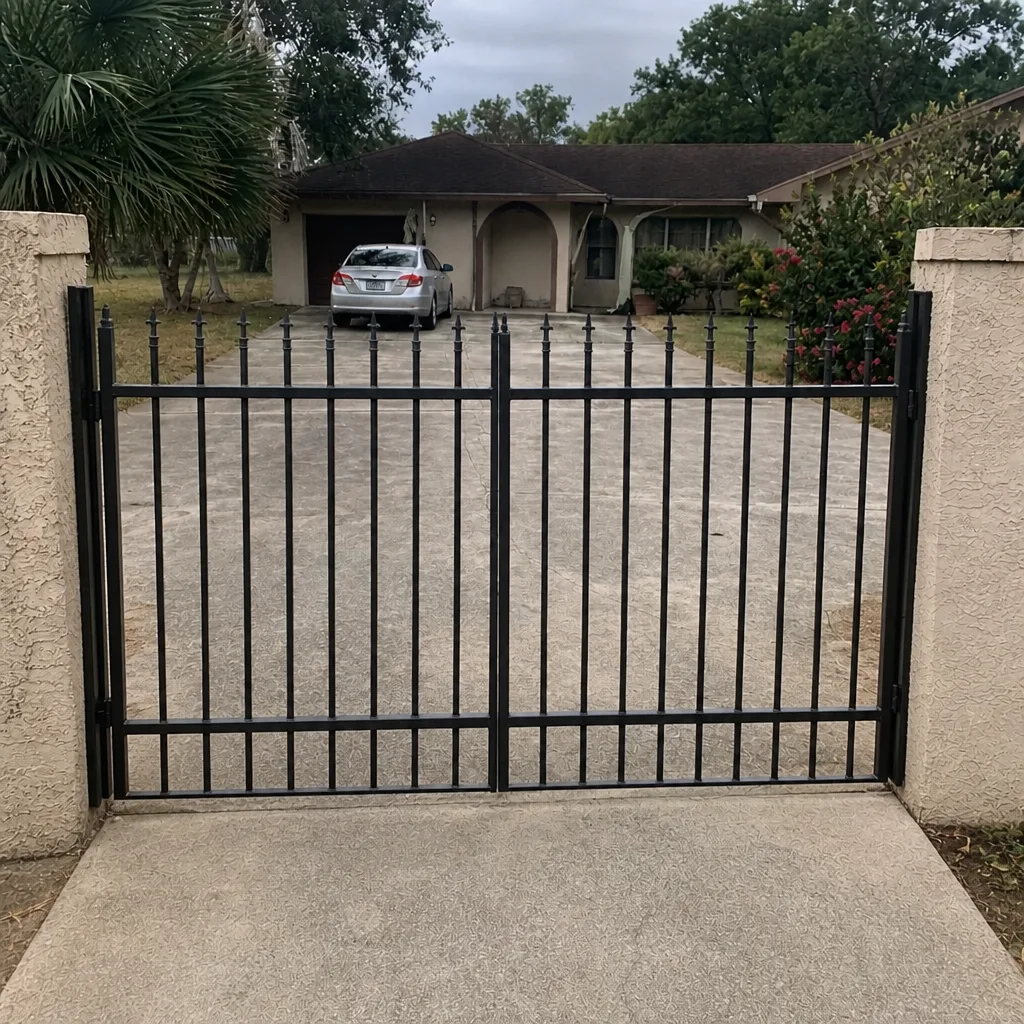
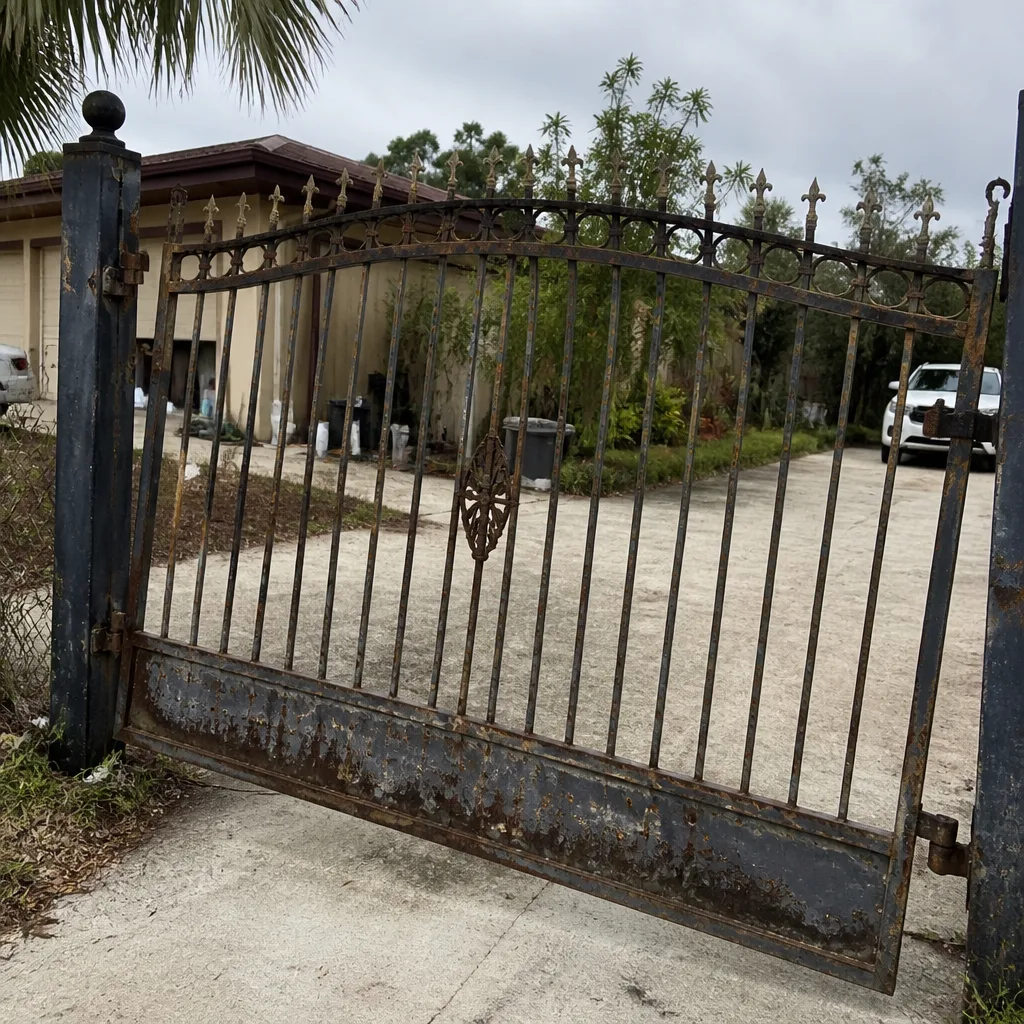
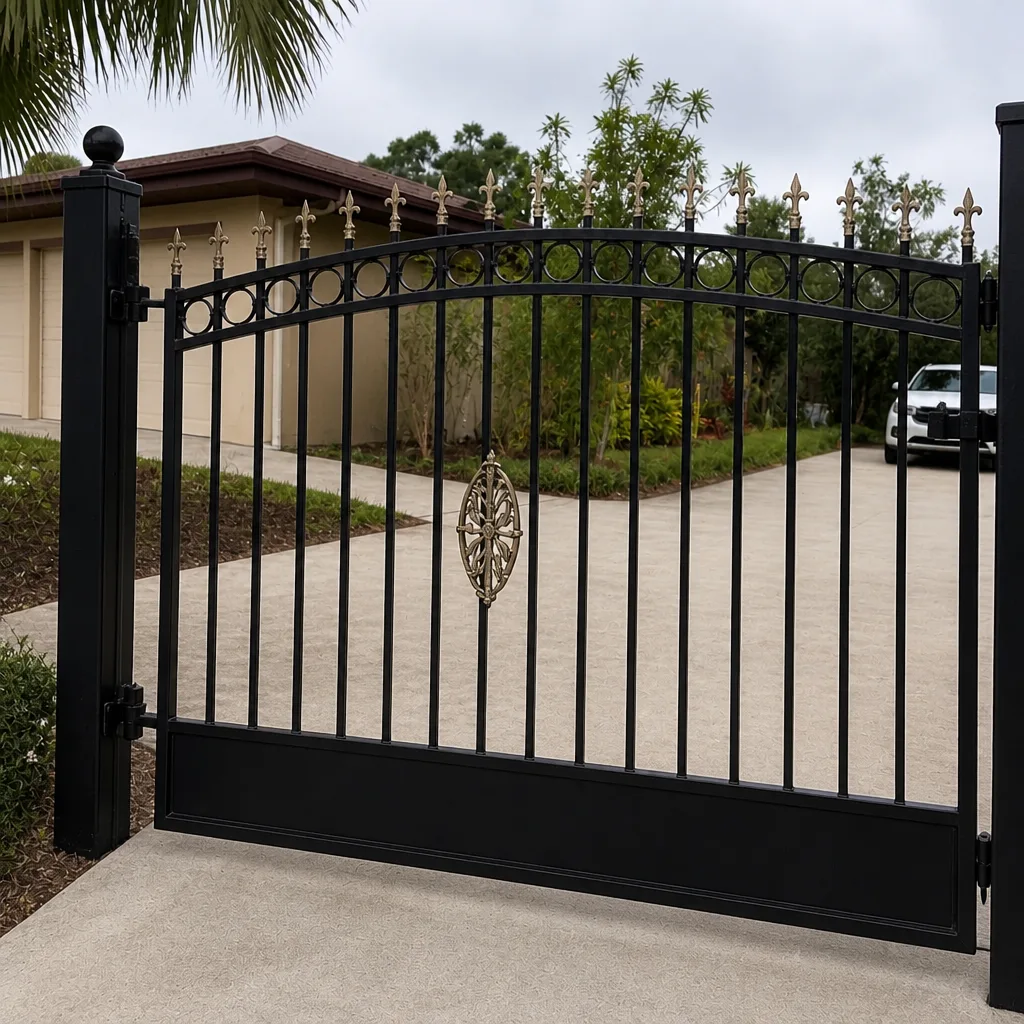
See the difference
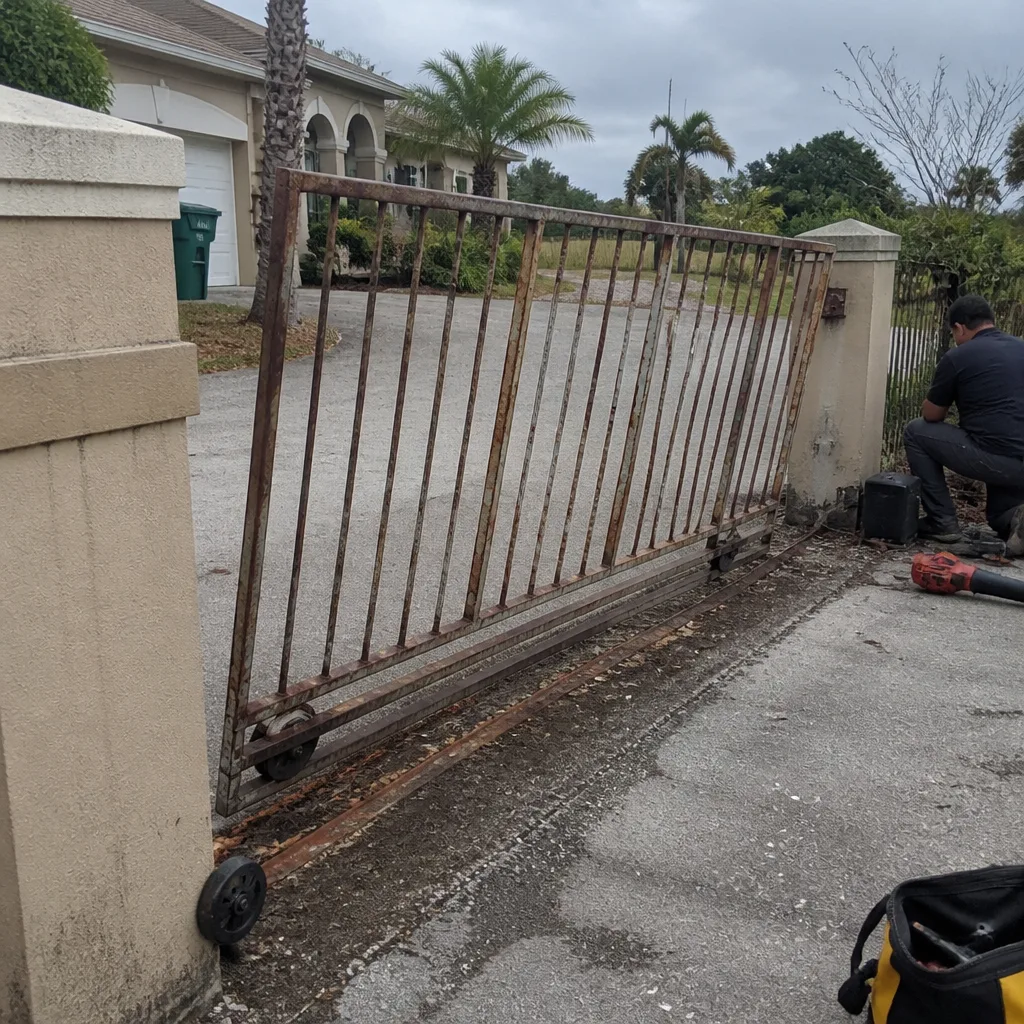 Before
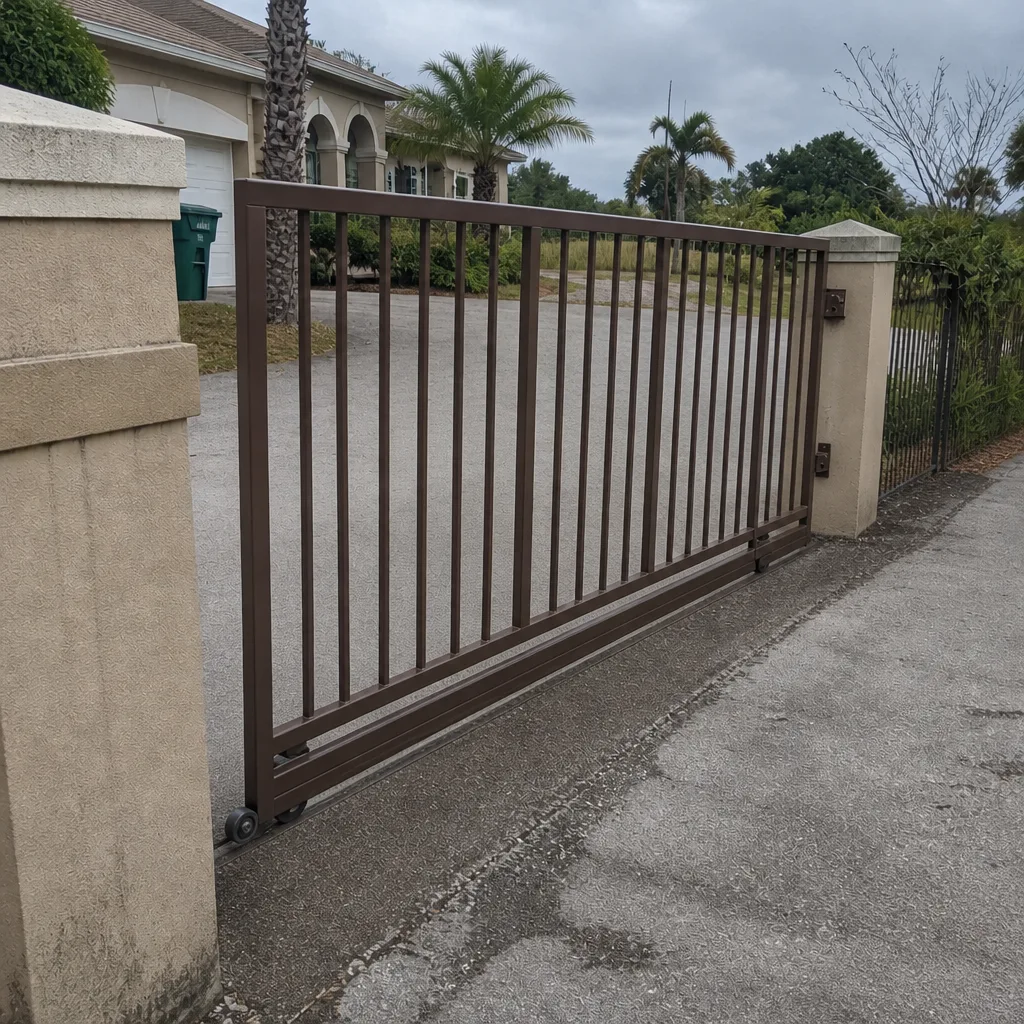 After
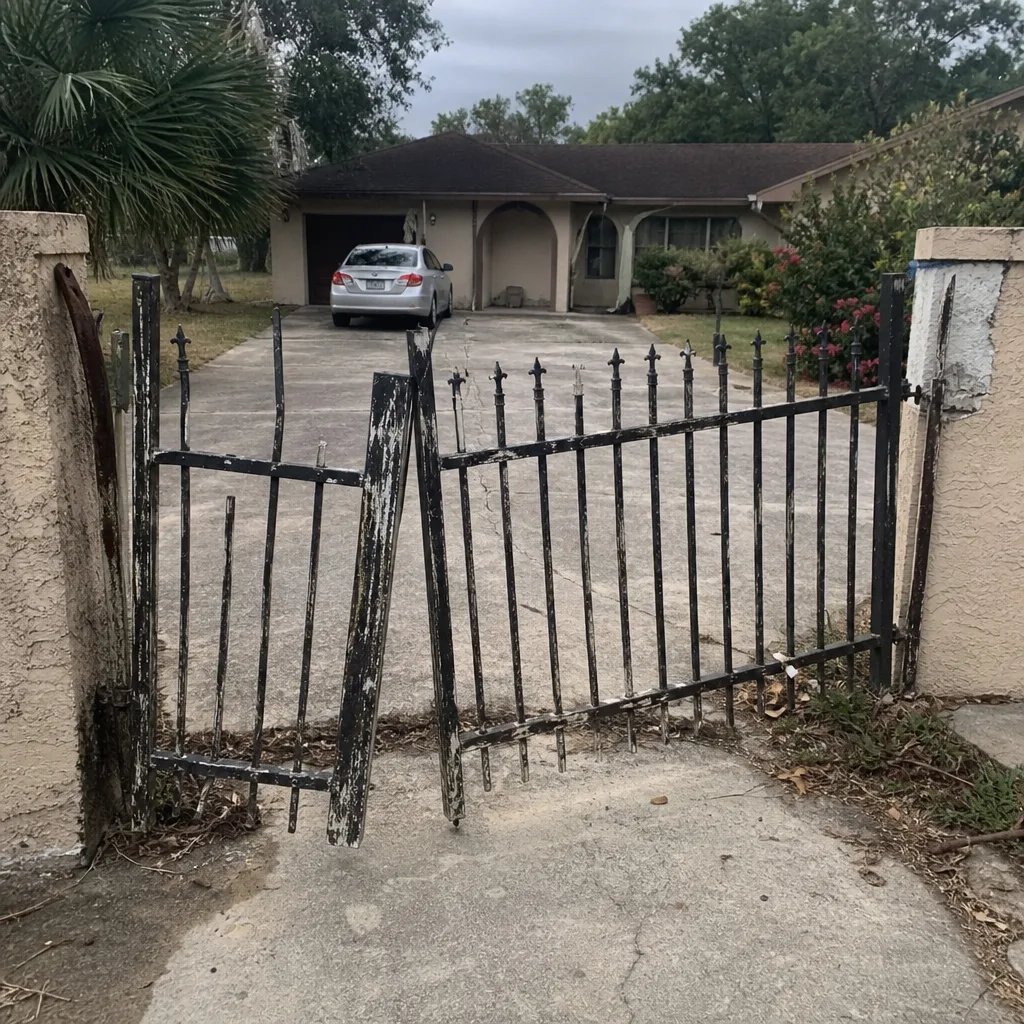 Before
 After
 Before
 After
When to Call a Professional
The monthly walk-around is for you. The internals are for us. Call a professional when the gate won’t reverse on a safety sensor, when the operator runs but the gate doesn’t move, when the control box or wiring shows water intrusion, when a hinge weld or post anchor is visibly failing, or when a loop detector misfires after a storm and re-sealing doesn’t fix it. Also call if you’ve been repairing the same component repeatedly; that pattern usually points to a root cause, not bad luck. Electric gates combine moving hardware with power and control logic, and some of those checks are not safe to do yourself, so leave the voltage work to a trained technician. Gate Repair Lehigh Acres offers free estimates in Lehigh Acres, and our technicians have up to 14 years of experience across nine gate brands. Call (888) 361-0704.
Frequently Asked Questions
Lubricate hinges, rollers, and latches every 60 to 90 days in the dry season and every four to six weeks during the rainy season. Use a PTFE-based or dry-film lubricant that resists humidity, not standard lithium grease. Call (888) 361-0704 for an exact quote on a maintenance visit – estimates are free.
April is the most important month, because it’s your last chance to prepare before the rainy season. Clear drainage, check loop detectors, clean solar panels, and test every safety device in April, then follow up with a post-storm inspection in November. Call (888) 361-0704 to schedule a spring inspection.
It could be either, but panel film and UV buildup are a common culprit in high-sun climates. Clean the panel, check for shading and wiring issues, then test output; if it still runs slow, the battery or charge controller is the next suspect. Call (888) 361-0704 for an exact quote – estimates are free.
A false trigger after rain usually points to an underground loop detector with a cracked seal or soil shift over the wire. Check the pavement sealant and the loop area first. If it keeps happening, the loop or detector may need professional service. Call (888) 361-0704 and we’ll take a look.
An annual inspection covers the operator, control board, wiring, safety devices, battery and charging system, heavy hardware, and loop detectors. It’s the internal check the monthly walk-around can’t do, and it’s best scheduled before the rainy season or after storm season. Call (888) 361-0704 for an exact quote.
You can and should do the monthly walk-around: hinge lubrication, safety sensor tests, and visual checks. Anything involving the operator, control board, wiring, or power should go to a trained professional, and so should any repair that keeps coming back. Call (888) 361-0704 for a free estimate.
The Bottom Line
A gate maintenance schedule in Lehigh Acres has to be built around local stress points, not generic manufacturer intervals. That means monthly hinge and sensor checks, a serious pre-rainy-season prep in April, careful lubrication with a humidity-resistant product, solar panel cleaning during the high-sun months, loop detector checks after heavy rain, and a professional inspection once storm season passes. Do the monthly walk-around and most failures never reach the operator. When something does, a specialist who knows the brand can diagnose it quickly and tell you whether repair or replacement is the better value. The calendar is yours to keep. The calls are ours to answer.
For a free estimate on gate repair, electric gate repair, or installation, call Gate Repair Lehigh Acres at (888) 361-0704. We answer 24/7. Fast dispatch from 7am to 7pm, Sunday through Friday.
Written by the team at Gate Repair Lehigh Acres.